Saturday, August 19, 2006

Tipping Point

There's often a tipping point where choices have more than a casual effect: they affect our lives. Sometimes, perhaps more often than we imagine, those decisions are made incorrectly, misguided or even purposely misdirected.

In a recent Newsweek article about Billy Graham, Jon Meacham wrote:
As he has grown older, Graham has come to an appreciation of complexity and a gentleness of spirit that sets him apart from many other high-profile popular religious figures. Graham prizes peace. He is a man of unwavering faith who refuses to be judgmental; a steady social conservative in private who actually does hate the sin but loves the sinner; a resolute Christian who declines to render absolute verdicts about who will get into heaven and who will not; a man concerned about traditional morality who will not be dragged into "hot-button issues" of the hour. Graham's tranquil voice, though growing fainter, has rarely been more relevant.

We are constantly being influenced to see and do things in ways that are often not our own choices: to buy, do, vote for or against, go places, etc. These temptations often tip our judgement and bend our personal ethics. When this happens in high places, it can affect our lives and livelihoods as has been the case with President Bush. We are tipping downward and wobbling out of control because of misguided or misdirected decisions he has made on our behalf.

Fortunately there is an election coming this November which can - if enough new and vocal congresspeople get elected - wobble us back up to a wavering tipping point once again - and this time we might be able to make the right choices.

Jon Meacham said it right (about Billy Graham) when he said that
Complexity should be appreciated and leadership should reflect and maintain a gentleness of spirit and a sense of brotherhood for all.
We've tipped away from that with polarizing "hot-button issues" like immigration, gay marriage, and mean-spirited aides to the President like Cheney and Rove. It's time to tip back toward fairness, gentleness, altruism and brotherhood.

Thursday, August 17, 2006

A Timely Indian Prayer

By Tom Whitecloud
Florida, circa 1700

Oh Father whose voice I hear in the woods
and whose breath gives life to all the world, hear me.

I am a man before you; one of your many children.

I'm small and weak; I need your strength and wisdom.

Let me walk in beauty and make my eyes ever behold
the red and purple sunset.

Make me wise so that I may know the things you have taught my people;
the lessons you have hidden in every leaf and rock.

Make my hands respect the things you have made;
my ears sharp to hear your voice.

I seek strength Father; not to be superior to my brothers,
but to be able to fight my greatest enemy: myself.

Make me ever ready to come to you with clear hands and straight eye,
so that when life fades as the fading sunset,
my spirit may come to you without shame.

Monday, August 14, 2006

Legacy/Schmegacy! Ex-Pres. Carter Speaks Out.


As a followup to my open letter to Ex-President Clinton (and my response to a reporter friend's questions about Clinton's legacy issues), here's an example of how a legacy is being created, day-by-day, by another ex-president.

In an August 2nd interview with Der Spiegel, Ex-President Jimmy Carter said:
CARTER: Our country always had a policy of not going to war unless our own security was directly threatened and now we have a new policy of going to war on a preemptive basis. Another very serious departure from past policies is the separation of church and state. This has been a policy since the time of Thomas Jefferson and my own religious beliefs are compatible with this. The other principle is basic justice. We've never had an administration before that so overtly and clearly and consistently passed tax reform bills that were uniquely targeted to benefit the richest people in our country at the expense or the detriment of the working families of America.
Also:
SPIEGEL: But wasn't Israel the first to get attacked?

CARTER: I don't think that Israel has any legal or moral justification for their massive bombing of the entire nation of Lebanon. What happened is that Israel is holding almost 10,000 prisoners, so when the militants in Lebanon or in Gaza take one or two soldiers, Israel looks upon this as a justification for an attack on the civilian population of Lebanon and Gaza. I do not think that's justified, no.
And most importantly:
SPIEGEL: One main point of your book is the rather strange coalition between Christian fundamentalists and the Republican Party. How can such a coalition of the pious lead to moral catastrophes like the Iraqi prison scandal in Abu Ghraib and torture in Guantanamo?

CARTER: The fundamentalists believe they have a unique relationship with God, and that they and their ideas are God's ideas and God's premises on the particular issue. Therefore, by definition since they are speaking for God anyone who disagrees with them is inherently wrong. And the next step is: Those who disagree with them are inherently inferior, and in extreme cases -- as is the case with some fundamentalists around the world -- it makes your opponents sub-humans, so that their lives are not significant. Another thing is that a fundamentalist can't bring himself or herself to negotiate with people who disagree with them because the negotiating process itself is an indication of implied equality. And so this administration, for instance, has a policy of just refusing to talk to someone who is in strong disagreement with them -- which is also a radical departure from past history. And, of course, fundamentalists don't believe they can make mistakes, so when we permit the torture of prisoners in Guantanamo or Abu Ghraib, it's just impossible for a fundamentalist to admit that a mistake was made.

SPIEGEL: So how does this proximity to Christian fundamentalism manifest itself politically?

CARTER: Unfortunately, after September 11th, there was an outburst in America of intense suffering and patriotism, and the Bush administration was very shrewd and effective in painting anyone who disagreed with the policies as unpatriotic or even traitorous. For three years, I'd say, the major news media in our country were complicit in this subservience to the Bush administration out of fear that they would be accused of being disloyal. I think in the last six months or so some of the media have now begun to be critical. But it's a long time coming.
To Ex-President Clinton: I rest my case for alltruism rather than concerns of legacy.

To Ex-President Carter: Bravo for saying clearly and boldly what needs to be said. 

And to all of the rest of us, here's one more thing Carter said that involves us directly:
CARTER: There is a self-corrective aspect to our country. And I think that the first step is going to be in the November election this year. This year, the Democrats have a good chance of capturing one of the houses of Congress. I think the Senate is going to be a very close decision. My oldest son is running for the US Senate in the state of Nevada. And if just he and a few others can be successful then you have the US Senate in Democratic hands and that will make a profound and immediate difference.
Let's help that self-corrective aspect affect change this November.  Campaign for who you believe will make the boldest contribution, back your beliefs with money and action, and vote. I'll be doing the same.

Sunday, August 13, 2006

Was "Reutersgate" A Planned Manipulation?

Different angles of the same photo re-used on different dates. Photoshop manipulated clouds to emphasize smoke and bomb devastation. Non-existent rockets attacking a non-bomb-dropping jet.


The Los Angeles Times wrote:
"There are two problems here, and they're the reason this controversy shouldn't be allowed to sputter to its inglorious conclusion just yet:
  • One of these has to do with the scope of what strongly appears to be wider fabrication in the photojournalism Reuters and other news agencies are obtaining from their freelancers in Lebanon.

  • The other is the U.S. news media's grudging response to the revelation of Hajj's misconduct and its utter lack of interest in exploring whether his is a unique or representative case."
It seems obvious that some of the photojournalists involved are either intimidated by or sympathetic to the Hezbollah terrorists for them to fraudulently manipulate photos as they have done.

Or perhaps there are some bigger players involved. This could be just the sort of trick that Rolling Stone's James Bamford wrote about when he was describing the activities of John Rendon and his Rendon Group on behalf of the CIA and DoD. In that expose Bamford described a scene where a terrorist described an event that was going to happen but when he was given a lie-detector he failed completely.
The fabrication might have ended there, the tale of another political refugee trying to scheme his way to a better life. But just because the story wasn't true didn't mean it couldn't be put to good use. Al-Haideri, in fact, was the product of a clandestine operation -- part espionage, part PR campaign -- that had been set up and funded by the CIA and the Pentagon for the express purpose of selling the world a war. And the man who had long been in charge of the marketing was a secretive and mysterious creature of the Washington establishment named John Rendon.

Rendon is a man who fills a need that few people even know exists. Two months before al-Haideri took the lie-detector test, the Pentagon had secretly awarded him a $16 million contract to target Iraq and other adversaries with propaganda.
If the shoe fits . . . ?

Perhaps we could eliminate from our governmental expenditures monies that pay for the Rendon Groups activities along with the blatently campaign activities being done from within the Whitehouse by Karl Rove. It might not save much in dollars but it could reduce tensions and false illusions by quantum leaps.

The Black Kettle* Has a Few Good Ideas


[* from the old saying "A pot calling the kettle black" which comes from old times when pots and pans were generally black and kettles were generally metallic and reflective. Therefore the pot sees its black reflection in the kettle and thinks that the kettle is black.]

"I am a politician," Rendon said in a 1998 speech to the National Security Conference (NSC), "and a person who uses communication to meet public policy or corporate policy objectives. In fact, I am an information warrior, and a perception manager. This is probably best described in the words of Hunter S. Thompson, when he wrote 'When things turn weird, the weird turn pro.'"

At a recent lecture in San Francisco, John Rendon, owner of The Rendon Group, was booed and jeered and his speech intrerrupted - but he also made some suggestions that merit repeating.

Rendon used to be a Democrat player. He worked in big campaigns and as the Executive Director of the DNC. But in 1991 he branched away from Democratic politics and began providing public relations services for the CIA and DoD (amongst others). He became a disinformation provider and privy to more polling and survey data than any single campaign or party could ever muster. He began using his campaign skills to enable our foreign policy and psyops programs to operate more successfully by missusing those very tools and practices very similar to the way the Reuters and AP photo journalists are missusing their photos from Lebanon by using Photoshop image manipulation techniques.

At the San Francisco lecture he recited facts and figures that could only come from the CIA's resource database (at least I hope they were "facts"). You can listen to the complete lecture by downloading the podcast from iTunes.

The lecture was interesting to me because of the case Rendon made of how little we really know about what we're doing throughout the world. The information isn't flowing in because we don't want to hear it, because we are often misdirected, and because there are some (himself included) that are using psychological and manipulation tools to make us too fearful to want to know. Further, our resources for alternate and competing information (returning travelers, foreign news sources, international travel) is being limited by the polarization that we see increasing daily in our congress and state and local chambers.

He claimed that as polarization increases (often accelerated by his company's efforts), balanced views of the world disappear and are replaced by selective information that supports the particular polarized group that the viewer belongs to and that these two suggestions would help mitigate that effect. Rendon suggested that we could alter our centrist view of the world by bringing more of the world to our news sources:
  • Require every news agency that has a federal license to have at least 10% of their reportorial staff exchanged with a foreign news agency

  • Require that before any college degree is awarded that the student have at least two years of foreign travel under his or her belt
He said that these two suggestions were the least that we could do to tip back America's lack of balanced information needed for understanding, planning and governance - an imbalance that, in part, he helped tip.

Saturday, August 12, 2006

Re: Open Letter to Bill Clinton

A reporter friend asked me to comment about a story he is writing about the tension between Clinton's two great desires:
  • To be a beloved post-partisan ex-president helpful in all the world statements-type responses to international events

  • To be the Democratic Party's unofficial leader and first-ever First Gentleman
I think that Bill Clinton’s legacy would be enhanced if his immediate political activities were more altruistic than helping his wife get elected.

The new president has a lot to repair both within and outside the US. He or she should have the best team and support with the least diversion of attention to scrapping and other shenanigans.

Hence my suggestion that Clinton draft (and craft) Gore and participate in the solutions rather than contributing to the problems. Insuring that a Democratic President gets elected and a get-things-done team of straight shooters is placed is far more important in this next cycle than electing Hillary (who, in my opinion, is not the right person for this particular time).

Gore has a passion to effect change regarding our immediate environmental problems and he has knowledge and experience with cleaning up our government and extricating all of the cancerous corruption, evil policies, poison pills and hateful and wrongheaded initiatives that the present administration has embedded. He’s not a corrupt man and has the integrity to remain so. With the Clintons onboard as UN Ambassador and Secretary of Health and Human Services (for example) everyone would see by their selfless example that repairing our country is far more important than any sense of entitlement or legacy building.

What better legacy than that?

Saturday, July 22, 2006

An Open Letter to President Bill Clinton


Hello President Clinton,

In the 2006 California governor's primary, Steve Westley said some things about Phil Angelides that the Reps are using in their ads against Angelides.

I'm sure that the same will be true in the CT senate race against Lieberman or Lamont because of the rhetoric that's been flying every which way there.

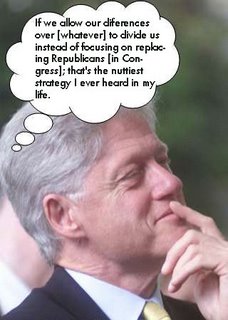
You said yourself the other week in Aspen that: "If we allow our differences over [whatever] to divide us instead of focusing on replacing Republicans [in Congress]; that's the nuttiest strategy I ever heard in my life."

I have a suggestion that you might find hard to swallow BUT might also think is the right thing to do:

  • Convince Hillary NOT to run for President in 2008 AND

  • Develop and manage (with Hillary) a Draft-Al-Gore campaign for President because:
All these points have public appeal, and with your support (and without the conflict of Hillary's candidacy) could make the difference in what portends to be a very close, costly and bitter race.

And count on me for support in money, effort, technology and whatever else is needed.

Thank you for your consideration.

Ex-Politico

Wednesday, July 12, 2006

Internet Privileged vs. Internet Resistant and the 2008 Election Cycle


Fellow bloggers, political browsers, and members of Daily Kos are the privileged ones. We can handle ourselves on the Internet; find what we want; view and listen and comment. We're not intimidated by blogs, vlogs, podcasts, etc. And when it comes to campaigning, we're more interested in getting the facts on our own rather than being told what they are through advertisements.

So who are the underprivileged; the resistant*? This group is equally important because they are also prime targets for the 2008 Election Cycle. If we don't find and identify this group they might miss the massive amount of real information, our candidate's information, and the pleasure of independent research.
People who were 12 or younger in 1992 were on the cusp of the Internet revolution. They learned it and took it for granted and are adept at navigating and searching for whatever they want. They gather information as they become interested; they participate when the feel like it; they buy confidently, contribute freely, and disseminate regularly. So the campaign pitch to those folks is to interest them in finding out more; doing more; thinking more; participating more; contributing more.

The older groups of 1992 contained many of the resisters, particularly in the 1992 age range of 40-65 who are now 55-80. Some of the seniors within that group have learned what it is and how to use it because it's their primary source of communication with their dispersed families, but they're not really at ease with all the capabilities and features. The remaining group of AARP-elegibles are prime targets for traditional advertising and also for sympathetic Internet training.

Segmenting the electorate into Internet saavy versus traditional and also by Internet resistance versus taking it for granted are necessary first steps toward making the 2008 Presidential Election our first real Internet-as-primary-media election.

Bob Schieffer of CBS News made a good point when he hosted "The Charlie Rose Show" and interviewed Jonathan Alter of Newsweek a few weeks ago. He said:
Successful presidents have all skillfully exploited the dominant medium of their times.

  • The Founders were eloquent writers in the age of pamphleteering.

  • Franklin D. Roosevelt restored hope in 1933 by mastering radio.

  • John F. Kennedy was the first president elected because of his understanding of television.

  • And with an issue as eye-glazing as the deficit, a wacky, jug-eared Texan named Ross Perot received 19 percent of the vote. He did it with "Larry King Live" and an 800 number.

Howard Dean and later John Kerry showed that the whole idea of "early money" is now obsolete in presidential politics. The Internet lets candidates who catch fire raise millions in small donations practically overnight. That's why all the talk of Hillary Clinton's "war chest" making her the front runner for 2008 is the most hackneyed punditry around. Money from wealthy donors remains the essential ingredient in most state and local campaigns, but "free media" shapes the outcome of presidential races, and the Internet is the freest media of all. Finally, since at least a quarter of the voting population voting early or absentee, traditional methods of advertising are diluted further still.

The 2008 presidential election cycle will begin shortly. I believe, like Schieffer, that he who masters the prevailing media will win. That media used to be TV but by 2008 it will be the Internet - and we are all players in this new drama.

Be sure to vote.

* Cartoonist Mike Reed became famous a few years ago because of a flame-out he had with a few people on a digital arts forum. He was silent for a few weeks and then came back with a dozen cartoons that expressed his anger. Appreciation of those cartoons led to a book called "Flame Warriors."

Tuesday, July 11, 2006

A Little Heart, A Lot of Brotherhood vs. the Politics of Fear

A recent interview in BusinessWeek with George Soros:

"The Bush Administration and the Nazi and Communist regimes all engaged in the politics of fear."

Do you really believe the Administration is a threat to democracy?

Yes, I really do believe that, and that is why I got involved in politics. By claiming to engage in a war against an unknown enemy that will never disappear... President Bush has appropriated excessive powers for the executive branch... undermining the division of powers that have been the mainstay of our democracy. In addition, he succeeded for a while in making any criticism of his policies appear as if it was unpatriotic. That undermines the first principle of an open society: critical thinking.

Your book dwells on the negative. Don't you run the risk of being perceived as a very wealthy Chicken Little?

I do. But I contend that we have become a feel-good society unwilling to face harsh reality. As a result, reality has become increasingly threatening.

Remember Lee Atwater? How ruthless he was? How harsh? How his words were so well chosen that they drilled their message into the hearts of the intended victims but sailed by everyone else?

Did you know that Bush was good friends with Atwater and worked across the hall from him during his father's campaign for president and encouraged his father to heed to Atwater's advice when it was cruel even to Bush Sr.? W learned from and repeatedly endorsed Atwater's tactics and practices. One of Atwater's lessons was repetition. Repeat a key phrase or idea from a variety of sources and people's disbelief will slowly deteriorate. You see this daily in DC with statements eminating from Rove's office delivered as talking points from the Speakers office, the RNC and various Rep candidates across the country.

Having been in that business and known the players - including Atwater - it's hard to be compassionate to Bush because he knows what he is doing. And I don't feel that I'm naive in this belief because I knew Atwater and felt the blows of his attacks and the pain of his victories. It was good training for Bush and there's no doubt that he was a quick and thorough learner.

Atwater came to recant what he had done.

In a February 1991 article for Life Magazine, Atwater wrote:


My illness helped me to see that what was missing in society is what was missing in me: a little heart, a lot of brotherhood. The '80s were about acquiring -- acquiring wealth, power, prestige. I know. I acquired more wealth, power, and prestige than most. But you can acquire all you want and still feel empty. What power wouldn't I trade for a little more time with my family? What price wouldn't I pay for an evening with friends? It took a deadly illness to put me eye to eye with that truth, but it is a truth that the country, caught up in its ruthless ambitions and moral decay, can learn on my dime. I don't know who will lead us through the '90s, but they must be made to speak to this spiritual vacuum at the heart of American society, this tumor of the soul.


It took a fatal brain tumor to elicit Atwater's poignent repentence. I don't see anything short of that which could shake President Bush's repeated lies and reliance on Rove and others who daily repeat Atwater's worst traits.

Soros is right: there are harsh realities that are slipping away from us day by day by the repeated diversions, fear and bickering of the Bush Administration.

It's time for people in the news to return to being investigative reporters instead of repeaters of Administration stuff. Doesn't any newspaper or magazine have an investigative reporter and editor willing go after Rove and Bush and stand up to the harassment that is sure to come?

Friday, July 07, 2006

Open Letter to the Editor of Time Magazine


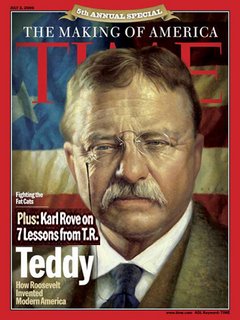
I'm astounded that Time chose Rove for "Lessons from a Larger-than-Life President" (with a cover highlight) for your Teddy issue (which I very much enjoyed and appreciated (sans Rove)).

He was cited as a history buff. Actually he is more of a malicious political trickster. He has learned how to misuse and manipulate the system and the people who depend on it. During his time in the campaign process, and now on the federal payroll, he has undermined trust, accelerated fear, spread rumors, cultivated a culture of religious elitism, and disseminated so many attacks that he can hardly be a credible addition to your magazine's cadre of respectable reporters.

One blogger, in response to this article, said that Rove "should be kept away from elections for the same reasons we keep Charlie Manson away from the cutlery. And not only that, but he's the guy who spent a flat year hanging one of Time's own reporters out to dry! Rove's a vandal and a thug who would tear the Time-Life Building down for a parking lot if he thought it would mean five points on the next Gallup Poll."

Instead of adding articles from Rove, Time should be writing articles about the terrible things that Rove is doing while we, as taxpayers, are paying him. Isn't that a crime? Doing the things he does on the government payroll? Doesn't Time have an investigative reporter and editor willing go after him and stand up to the harassment that is sure to come?

I hope so!