Friday, June 17, 2011

Transitioning from Industrial to Service/Personal Robotics


Will big industrial robot makers such as ABB, Fanuc and Kuka, transition and begin making products for the consumer and service markets? I'm beginning to think not. And here are a few of my reasons:

I've been impressed by the possibilities for power companies to reduce costs and expand safety and efficiency by adapting robots for high voltage transmission line maintenance and inspection instead of their present methods. Consequently, I researched and found some interesting Japanese and Canadian robotic solutions - and also an American one scheduled to debut in 2014 - and suggested these three options to the companies that presently perform line inspection and maintenance.  I commented that this was the wave of the future and asked them whether they were going to use them. There was little, if any interest in doing so.

This lack of interest is not unique to the power industry.  When I talked with the big industrial robotic vendors I received the same message when I asked about the possibilities of their producing social and work-place-assistant robots or using open or non-proprietary operating systems and even using non-proprietary devices like an iPad or tablet for programming and training.

The resistance is on many levels: job protection, revenue protection, technology and systems protection, and product protection.  Notice the "protection" in each phrase? That's the main problem.

Bill Clinton, in a recent commencement speech at NYU, said that in the last 30 years companies have come to believe that they have obligations only to their shareholders.
The problem is that if you do that you ignore the other stakeholders. 
That could be why wages have been virtually stagnant for the past 30 years, because the workers are stakeholders. It could be why communities have been unable to undertake economic transformations in many places, because communities are stakeholders. It could be why customers don’t care so much what the source of their purchases are, they’re stakeholders.
He clearly said that the world we live in is too unequal; that the world we live in is unstable; and that the world we live in is unsustainable. [Abstract of Pres. Clinton's commencement address.]

In thinking about what he said and what I heard from the robot executives in relation to using robots instead of humans or helicopters to maintain and inspect power transmission lines. When helicopters are used companies that perform the service charge seven times the estimated cost of using a robot. Thus the profits derived are seriously more than would be derived from using a robot. Said another way, the profits from the sale of just one PacBot system is equal to the profits from the sale of 500 Roombas.

Protective and narrow thinking - as was expressed to me in many forms by the current vendors - is what will prohibit these vendors from transitioning into the different world of consumer/service robotics. That kind of thinking stultifies innovation and thwarts the goals of the corporation to all their stakeholders.

Consumer sales are whimsical, dependent on many variables.  Manufacturing and selling 500 or 5,000 or 5 million consumer products is an entirely different process than selling a single defense contract which rarely if ever ramps up into numbers over 100.

Further, defense, space and security robotics are mostly in the domain of large aerospace companies or spinoff startup companies from university research centers and derive their profits as a fixed percentage of their costs and overhead... a formula that doesn't translate into the commercial sector.

Finally, most service robots involve interactions with humans in human/robot roles entirely different than in a factory setting.

Therefore, I believe that disruptive startup companies will spin out of research facilities and throughout the world of inventors and venture capitalists and provide product solutions to consumer needs that they want to purchase. Further, I believe that the business model for these new companies is entirely different than the model for old-line robotic manufacturers and also the aerospace industry. Consequently, this will be a worldwide phenomena. With my US hat on, it means that the US has a fresh start at an industry that is soon to emerge: small business and personal service robots and vehicles.

Sunday, March 06, 2011

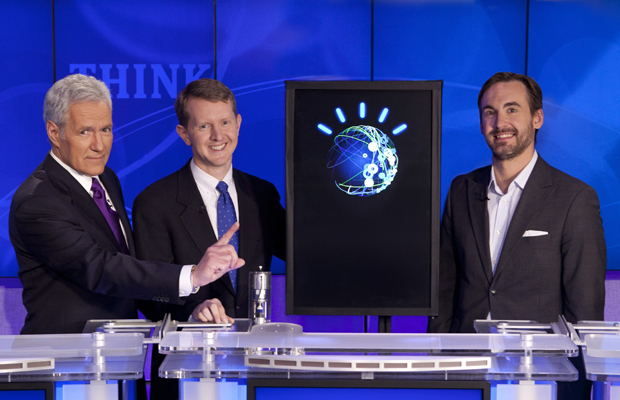
The Next 7-10 Years of IBM's Watson

Jeopardy! Was Just The Beginning

Alex Trebek, Ken Jennins, Watson and Brad Rutter
Photo courtesy of Jeopardy!
IBM's achievement with their Watson system and software was more than good television:
  • It's a major language processing realization. Computing systems will no longer be limited to responding to simple commands.
  • The data management aspect lends itself to specialization, ie, medical sub-sets, legal data sets, call/support centers databases, etc. John Markoff, in a recent NY Times article on the subject, said "any job that now involves answering questions and conducting commercial transactions by telephone will soon be at risk. It is only necessary to consider how quickly A.T.M.’s displaced human bank tellers to have an idea of what could happen."
  • The language processing is amazing, illuminating, and lets one dream of a future where the promises of human-robot (or for that matter, human-device) interaction and instantaneous translation is really going to happen soon.
  • A staggering amount of horsepower was harnessed to work harmoniously using massively parallel technology on 2,700 processors spread over 90 servers to enable the Jeopardy! win.  Historically, this will advance to smaller devices within a few years. Ray Kurzweil, quoted in The Economist, notes that it was only five years after the massive and hugely expensive Deep Blue beat Mr Kasparov in 1997 that Deep Fritz was able to achieve the same level of performance by combining the power of just eight personal computers. In part, that was because of the inexorable effects of Moore’s Law halving the price/performance of computing every 18 months. It was also due to the vast improvements in pattern-recognition software used to make the crucial tree-pruning decisions that determine successful moves and countermoves in chess. Now that the price/performance of computers has accelerated to a halving every 12 months. Mr Kurzweil expects a single server to do the job of Watson’s 90 servers within seven years—and by a PC within a decade. If cloud computing fulfills its promise, then bursts of Watson-like performance could be available to the public at nominal cost even sooner.
  • And most importantly, right after the Jeopardy! win, IBM announced partnerships with a few hospital groups to provide diagnostic physician assistance using Watson's DeepQA software and data management methods. And their website displays other areas where Watson might be particularly helpful. IBM is bringing Watson to the marketplace.
It's important to keep in mind that inside a computer there is no connection from words to human experience or cognition.  To Watson, words are just tokens. In parsing a question such as those on Jeopardy!, a computer has to decide what's the verb, the subject, the object, the preposition and the object of the preposition. It must remove uncertainty from words with multiple meanings, by taking into account any and all contexts it can recognise. When people talk among themselves, they bring so much contextual awareness that answers become obvious. The computer must use logic to "disambiguate" incoming tokens into choices which can be measured (scored) against alternative choices. And it must do all that within seconds.

What about robots and robotics?

The AI system managing a robot gathers facts through sensors or human input, compares this to stored data, and decides what the information signifies. The system then runs through various possible actions and predicts which action will be most successful.

Some robots also have a limited ability to learn. Learning robots recognize if a certain action achieved a desired result and store that information for the next time it encounters the same situation. Naturally, they can't absorb information like a human but in Japan, roboticists have taught a robot to dance by demonstrating the moves themselves.

It's important to remember that IBM isn't the only AI game in town. There are many companies and research facilities developing and providing AI software, the most visible of which is Google.
IBM 701 Computer
From Wired's Danger Room: Back in 1954, IBM announced that its 701 computer crunched a bit of Russian text into its English equivalent. A Georgetown professor who worked on the project predicted the computerized translation of entire books “five, perhaps three years hence.”

Thus was born a scientific (and sci-fi) drive that’s lasted 57 years, from Star Trek to Babel Fish to Google Translate: instantaneous speech translation. But even though no one’s mastered that yet, the Pentagon’s out-there research branch is asking for even more with its Boundless Operational Language Translation, or BOLT. As outlined in Darpa’s fiscal 2012 budget request. For the low, low starting cost of $15 million, Congress can “enable communication regardless of medium (voice or text), and genre (conversation, chat, or messaging).”  
Not only will BOLT be a universal translator — the creation of which would be a revolutionary human development — but it will “also enable sophisticated search of stored language information and analysis of the information by increasing the capability of machines for deep language comprehension. In other words, a 701 translator that works.
So What's The Holdup?

There are many reasons for the delay in robotic training and interaction with humans - some of which can been seen in the mammoth resources it took IBM to achieve their Watson Jeopardy! victory. You cannot place those resources into a robot nor can you rely on a computer controlling a robot (or series of robots) via a wireless communication channel as they go about their various tasks.

Matthias Scheutz, an Associate Professor of Cognitive Science, Computer Science and Informatics and Director of the Human-Robot Interaction Lab at Tufts University, adds research funding to the equation saying:
The fields of robotics and human-robot interaction are growing, with the highest expected growth rates not in industrial, but service robots. Several countries (Japan, South Korea, the EU, etc.) around the world are heavily investing in service and social robotics. In the US, there are very few funding programs specifically targeted at artificial cognitive systems that would enable complex autonomous service robots. My hope is that this will be changing soon given enormous market potential of this area and the heavy investments other countries are making. To keep the US competitive and to enable, not Watson-like, but more modest, more natural interactions between humans and autonomous robots in natural language, we will need interdisciplinary funding programs that are aimed at developing the right kinds of integrated control architectures for these systems, which we are currently still lacking.
Scheutz goes on to say:
Computing power is obviously a critical component for a lot of AI technology (e.g., algorithms that are data-based and need to be trained on large data sets, or algorithms that have to explore large search spaces in a short amount of time). Equally important is the architecture of an intelligent system, the way in which different components operate and interact. And here is where we have made much less progress compared to the hardware side. Consequently, although the performance of Watson is very impressive and clearly a break-through, from an engineering perspective, it does not yet address the problem of human-like natural language processing as we will need it for robots. And while there will likely be applications in the context of recommender systems in the near future, it is not clear to me how the technology used on Watson can be put on a robot and make it have natural task-based dialogues with humans.
The EU, Japan and Korea have roadmaps which lay out the science that needs to be tackled before effective products can be produced. And they have national direction and public-private funding to make their plans happen. America does not yet have such a plan nor any national direction regarding robotics. And this is a critical holdup.

President Obama, in his State of the Union Speech, specifically excluded robotics when he discussed the need for strategic investment in key areas of innovation. How the President could overlook that not a single sector is devoid of the applications of robotics is one question. Another is to ask whether he is aware that 12 of the 13 major robotic manufacturers selling industrial and manufacturing robots in the US are off-shore companies.

Sunday, January 30, 2011

A Sputnik II Moment


I was disappointed with the section of President Obama's 2011 State of the Union speech regarding investing in selected new technologies for future growth.

I had hoped he would use the word “robotics” and include the necessity for an American robotics industry in his speech and it is unfortunate that he did neither. That he focused his investment scope to exclude robotics might just be the death knell for the American robotics industry because, without national strategic focus, things will go on as they have… VERY slowly and very dependent on Space and Defense for research dollars.

A thriving robotics industry provides jobs, helps the nation increase efficiency, profitability and productivity and upgrades the mix of workers involved. Yet America doesn't presently have a national robotics agenda. Europe does. Japan does. Korea does. And each of these countries is gaining success and momentum worldwide.

Tom Atwood, editor-in-chief of Robot magazine, recently stated:
Although the government is beginning to wake up and push for an expansion of robotics education in schools with the DARPA-funded FIRE (Furthering Innovation through Robotics Exploration) program at Carnegie Mellon and the NSF-funded DARwIn-OP project at Virginia Tech, these and similar programs, by themselves, are not enough for our country to maintain its competitive technological edge. We need a national robotics policy that is specifically articulated in a clear call to action by our executive branch, and we need backing of such a program by Congress.
Pres. Obama was inspiring in his speech and his directness to the issues of the day, and his reference to a Sputnik II moment was wonderful as he attempted to address the need for American students to become involved in STEM (science, technology, engineering and math) programs. This is a serious issue and a major difference between America and all of the other countries in which robotics flourish: STEM education takes extra dedication, energy, time and persistence which is not happening with American students; in fact there seems to be resistance to pursuing a career in science (except for a career in medicine, or on the business side of math - as a quant - which, even today, still equates to enormously big bucks.) The Sputnik reference was eloquent but, at least for robotics, empty.

Microsoft Kinect - add-on device for Xbox game controller
He missed some great technology examples.  One that I find particularly illuminating is the effect that the technology inside Microsoft’s new Xbox Kinect device has had. Kinect is a controller free gaming and entertainment experience. It enables users to control and interact with the Xbox 360 game system without the need to touch a controller, through a natural user interface using gestures and spoken commands. Not only have sales of Xboxes exploded but so have the applications and uses - and sales - of the cameras and depth-perception software inside the Kinect. iRobot and WillowGarage are using the $50 Kinect innards in lieu of LIDAR range-finder machines costing upwards of $5,000. Check out iRobot’s new AVA concept robot. Hackers and inventors worldwide have been finding new uses for the Kinect that Microsoft didn't even dream of. Now that’s inspiring!

There are many things happening in robotics in America. There's work underway - with some successes thus far - to get an American robotics roadmap funded and implemented and there's been a steady trickle-down effect from the research dollars spent on defense and space by NASA, DARPA and the DoD. Medical robotics are on a tear. There is independent investment as well. In Wisconsin, Indiana, Georgia, Massachusetts and Alabama, state-, corporate- and educationally-sponsored Robotic Centers are springing up to provide training in the programming, repair and maintenance of robots, as well as for research and testing. Alabama's recently opened Robotics Technology Park is a serious $73 million three-pronged endeavor to provide (1) an industry training program where technicians will be trained to work on robotic machinery; (2) a test facility for NASA and the US Army for research and testing of leading edge robotics for defense and space exploration; and (3) a facility to allow start-up companies to build and adapt robots for new industries. Imagine if this kind of state-inspired public-private forethought were done on a national level... now that's a Sputnik II moment.

Alison Diana at InformationWeek just did a piece on 12 Advances in Medical Robotics but failed to note that 2/3 of the vendors were not American.  Eight out of the 12 were Japanese, Korean or European. The ratio of industrial robot providers in America is even worse: although integrators, engineers and consultants tend to be American-owned, the major robot providers (KUKA, ABB, Comau, Denso, Schunk, Motoman, Daihen, Reis, Fanuc) are all foreign-owned. That is also a Sputnik II moment.

English Teaching Robot
In South Korea, robotic guides and docents patrol the Presidential Museum as 70,000 monthly visitors experience an advertisement of the nation’s cutting-edge technologies that made it a global leader in chips, mobile phones, TVs, display panels, and robotics that combine them all. South Korea is into the 5th year of a 10-year $1 billion investment in robotic technologies with a series of national goals endorsed by their President.

An example of how a nationally-directed strategic program works is when a shortage of English teachers compelled the South Korea government to use robotic teachers. They are deploying them in 500 preschools in 2011, and 8,000 preschools and kindergartens by 2013. It helps address the lack of English teachers in rural areas or remote islands. Learning English represents a necessary educational step for competitive South Korean students, and especially those aiming to study abroad at major universities in the U.S. Now that's a Sputnik II moment.

This is what was missing from President Obama's speech: the recognition that part of the underbelly of America's productivity and efficiency is automation and robotics. It's a very necessary industry which needs national direction. Mark Ingebretsen, the new editor of Robotic Trends Business Review,  adds an additional dimension to Pres. Obama’s exclusion of robotics, “the robotics that drive America’s economy and defense will be in the hands of other countries that have spent the early 21st century developing robot technologies.”

President Obama's call for action using the Sputnik II example is moot in relation to robotics without the formulation and acceptance of a roadmap and the establishment of a public-private consortium to implement it fully. A roadmap was presented in May, 2009 and some of it's provisions are slowly making their way through the halls of Congress. But there is no executive leadership thus far. If there were, Pres. Obama's Sputnik II moment would be a true call to action instead of pointless rhetoric.

Saturday, January 01, 2011

Big Changes in Robotic Manufacturing

2011 is a pivotal year for industrial and service robots. In fact, we may see the marriage of industrial with service robots to be used as assistants in manufacturing. The recent launches in Europe of pi4-robotics' workerbot and Japan's Motoman's two-armed headless robot, and the anticipated 2011 launch in the U.S. of Heartland Robotics' factory assistant robot are examples of this trend.

Henrik Christensen (Director Robotics and Intelligent Machines, Georgia Institute of Technology) said in a recent ROBOTICA Forum:
In manufacturing only through use of automation can we reduce the need to out-source. Our workers are not going to be more effective in doing manual labor, but with the right tools they can be more effective and the motivation to outsource less pronounced. Companies are starting to realize that once you start an out-sourcing process it may result in all of the process going off-shore. That happened in textiles and apparel and the poster child in the IT industry is the IBM ThinkPad transformation to Lenovo laptops. Also the disk drive industry had a similar move to Singapore.

To be effective, robots have to be lower cost and higher dexterity. We are starting to see this - and the cost of integration is also coming down.
The recently released 2010 robotics industry reports from the International Federation of Robotics said:
Dramatic advances in robotics and automation technologies are even more critical with the next generation of high-value products that rely on embedded computers, advanced sensors and microelectronics requiring micro- and nano-scale assembly, for which labor-intensive manufacturing with [low-skilled] human workers is no longer a viable option.
Here are some quotes from the Heartland Robotics website that are more real than hyperbole:
Today's manufacturing robots are big and stiff, unsafe for people to be around, engineered to be precise and repeatable, not adaptable. Normal workers can't touch them.

Our robots will be intuitive to use, intelligent and highly flexible.  They'll be easy to buy, train, and deploy and will be unbelievably inexpensive.
Similar wording can be found on the pi4-robotics website and Motoman's.

Today's industrial robots are truly expert systems

Lest we forget, industrial robots encapsulate years of translating the skills of craftsmen to the mechanical capabilities of robots.  There's no other way that robots could have replaced their human counterparts were it not for the fact that the robot can do the same task equal to or better than the human.

Industrial robots in car factory
The know-how, where robots mimic human actions in the various aspects of the auto industry, represents decades of accumulated knowledge transfer by veteran craftsmen.

In welding, for example, the finish of welding varies, depending on the kind of metal used, its thickness and the power voltage. Craftsmen adjust the speed of welding by observing how sparks fly to get the best finish. From a story in Asahi:
About 10 years ago, Yasakawa (Motoman) started filming its craftsmen at work, using a high-speed camera to record their hand movements. The accumulated data was programmed into robots to enable them to perform tasks from several thousand options of welding that craftsmen had established over the years.

Because Yaskawa makes and uses robots at its main factory, it enables the company to pass along technical expertise from elders to their juniors.

"You can copy a robot, but not control technology that craftsmen created," said Junji Tsuda, president of Yaskawa. "(Exporting robots) is like shipping the craftsmen themselves."

"Chinese and South Korean makers are less likely to come up with such technology because they are more inclined to want results in the short term," said Akira Yoshino, the engineer-inventor of the lithium-ion battery.
Presently, robots in manufacturing are, except for the auto industry and welding apps, mostly involved in post processing and packaging rather than in the manufacturing process. [This latter point is not to be minimized - in fact, it is a booming area of robotics: picking, packing, packaging, processing, sorting and warehousing.]

But not general manufacturing!

The near-term future will see the gradual appearance of multi-purpose, flexible, easily trainable robots. We are likely to see the bridging between the expert systems of the past and these flexible systems of the future - in manufacturing in 2011.

I see three issues involved:
  1. Robotics for Small and Medium-sized manufacturers and factories (SME's)
  2. National strategies to solve important issues
  3. Training and retraining people for the future
SME's are the life-blood of the middle class and the area of greatest jobs growth.  SME's create new jobs, contribute to the community, and produce needed products.

Yaskawa Motoman
Two-armed Factory Robot
A few years ago, in Europe, the EU recognized the need to support SME businesses with improved robotics - robotics that were easily trainable, safe to work alongside, relatively inexpensive and flexible enough to handle all sorts of ad hoc tasks in any quantity. The EU invested in the development of SME robots because they felt that without their investment production efficiencies couldn't be maintained and more and more manufacturing would move offshore. The SME project ended early in 2009 and the consortium members quickly brought products to market that address the needs of SME's. These include two-armed robots, safety sensors and train-by-example programming. The EU also invested in the PiSa Project which had a similar goal.  The pi4-robotics "workerbot" mentioned above is the result of that effort. Motoman's two-armed robot is an outgrowth of the SME project and is presently replacing older robots in the Mercedes factories.

America doesn't have a national robotics agenda (roadmap) just yet even though there is effort in that direction. Congress was presented with a roadmap in May, 2009. There has been some movement from the Obama Administration's Office of Science and Technology Policy including some SBA funding and some targeted areas of robotic development funding opportunities from five different government agencies. But robotics are not yet on the national agenda - there's no U.S. Robotics Initiative as there is for other areas of development.

Nor is there a real training and retraining mechanism for keeping up with the changing technological landscape. Instead, we fear losing jobs rather than understanding that we will instead change the mix of workers (as is generally the case when robots enter the picture).  Yes we have FIRST programs, and interesting robo-competitions all oriented to interest students in STEM education. But we are very lax in our science education overall and really don't have a national reeducation program for our workforce.

What America has is an entrepreneurial system of funding (which I described back in January ("Financing the Strawberry Project")) supplemented by irregular special purposes like national defense (DARPA), homeland security and space exploration. If an inventor/business has a good enough idea to get past the angel investors and on to the real VCs, he/she will get enough money to get it off the ground.  It's part salesmanship, part product, and timing, rather than an outgrowth of a national agenda to help society.

It's great to wish Heartland Robotics well but it isn't right that they are America's only knight in shining armor (if it turns out that they really are). Also, if they are successful they will be contributing to the jobs issue by changing the mix of workers from low-skilled to highly skilled. Without a retraining program in place, there will likely be serious repercussions, a lot of bad press, and slowdowns.

Bill Gates, Samsung, the government of South Korea, Toyota, Ray Kurzweil and many others are predicting that there will be a robot in our homes, companies and cars in this decade.  It truly is a political issue - one of technological complexity, national importance and economic strategy - to make sure that we don't derail ourselves with pettiness, greed, apathy and inaction.

Tuesday, November 02, 2010

What's happened to the American dream?

On this election day I cannot help but consider whether Arianna Huffington's "Third World America" book is more than just a warning.

Graphic from AStrangeLife
James Truslow Adams coined and defined the American Dream as:
The American Dream, that has lured tens of millions of all nations to our shores in the past century has not been a dream of material plenty, though that has doubtlessly counted heavily. It has been a dream of being able to grow to fullest development as a man and woman, unhampered by the barriers which had slowly been erected in the older civilizations, unrepressed by social orders which had developed for the benefit of classes rather than for the simple human being of any and every class.

Home ownership is sometimes used as a proxy for achieving the promised prosperity; ownership has been a status symbol separating the middle classes from the poor. Sometimes the Dream is identified with success in sports or how working class immigrants seek to join the American way of life.
Thus the American Dream isn't to be rich; it's to be middle class, relatively content, and with trust that the future will be equal or better for the offspring.

Not only has that trust eroded, it's being chipped away daily by greed, temptation, outright corruption, misdirection and obfuscation, and passivity.

Right now 2/3 of Americans believe that their children will be worse off than they are now.  Two-thirds! Yale's Jacob Hacker says that 40% of all household income gains over the last generation, from 1979 to 2007, went to the richest 1% of Americans. Consequently, as more and more wealth goes to the top, people in that group lose sight of the American Dream and use their wealth to buy politicians, lawyers and PR/Communication specialists to turn government into an instrument where they can have their way.

Consider this story by Kurt Kleiner in MIT's TechnologyReview:
BOGUS GRASS-ROOTS POLITICS ON TWITTER 
Data-mining techniques reveal fake Twitter accounts that give the impression of a vast political movement.

Researchers have found evidence that political campaigns and special-interest groups are using scores of fake Twitter accounts to create the impression of broad grass-roots political expression. A team at Indiana University used data-mining and network-analysis techniques to detect the activity.

"We think this technique must be common," says Filippo Menczer, an associate professor at Indiana University and one of the principal investigators on the project. "Wherever there are lots of eyes looking at screens, spammers will be there; so why not with politics?"

The research effort is dubbed the Truthy project, a reference to comedian Stephen Colbert's coinage of the word "truthiness," or a belief held to be true regardless of facts or logic. The goal was to uncover organized propaganda or smear campaigns masquerading as a spontaneous outpouring of opinion on Twitter—a tactic known as fake grass roots, or "Astroturf."

Menczer says the research group uncovered a number of accounts sending out duplicate messages and also retweeting messages from the same few accounts in a closely connected network. For instance, two since-closed accounts, called @PeaceKaren_25 and @HopeMarie_25, sent out 20,000 similar tweets, most of them linking to, or promoting, the House minority leader John Boehner's website, gopleader.gov

In another case, 10 different accounts were used to send out thousands of posts, many of them duplicates slightly altered to avoid detection as spam. All of the tweets linked back to posts on a conservative website called Freedomist.com.
This is not atypical. It's just more sophisticated. Whatever it is, it's deceitful and corrupt, not public-spirited... and very likely to get worse.

James Gilligan, psychiatrist and author, said in his book "Violence: Reflections on a National Epidemic:"
The main social and economic causes of violence are those that divide the population into the superior and the inferior, the strong and the weak, the rich and the poor.  The more highly unequal a society is, the higher its rates of violence.  A greater level of equality is essential in order to curb both interpersonal violence and collective political violence. 
Thus the ever-increasing prison population, the unintended but predictable consequence of income disparity, lack of trust and growing poverty. And the ever-increasing use of professional manipulators like Karl Rowe, Fred Malek, Carl Forti and other operatives and communicators Roger Ailes, Glen Beck and Rush Limbaugh all of whom are now armed with unlimited and unidentified corporate contributions in almost unlimited amounts.  Very scary!

Awareness is the first condition of change, hence this message. Maybe we all should read Arianna Huffington's book.

And civility in incremental actions might be the next step.  President Obama said today that it was incumbent on all of us, when we feel it's appropriate, to "disagree without being disagreeable."

And John Stewart ran a whole rally last Saturday on the Washington, DC Mall predicated on that single point.

Friday, October 29, 2010

Do robots take away jobs or just change the mix of workers?

All of us are thinking about jobs and the economy, and those of us that are techno-centric are also concerned about the discussion as to whether robots take away jobs -- or not. It's an argument that's been going on since the invention of robots. Hollywood has vilified robots while Asians think of them reverently. Nevertheless, the question is valid and disruptive. Disruptive in the sense that jobs are lost when a superior technology emerges - think workhorses when cars started to be mass-marketed. Our present digital era is a disruptive one.

Distributing the workload increases skill levels - think Microsoft Word versus stand-alone word processors, or travel agents when e-tickets and online airline websites surfaced.

Jeanne Dietsch, CEO of MobileRobots, said in her blog earlier this year:
Did people lose jobs to computers? Yes, a number of secretaries had to upgrade their skills, and executives who refused to learn to type had a tough time of it, just to cite two examples. But these jobs were replaced by tens of thousands of high-paying software engineering positions, plus computer installers, computer operators, data storage firms and more.
A very thoughtful and well researched paper about jobs and automation appeared in Good Magazine's "Automation Insurance: Robots Are Replacing Middle Class Jobs:
MIT economist David Autor
MIT economist David Autor published a report that looked at the shifting employment landscape in America. He came to this scary conclusion: Our workforce is splitting in two. The number of high-skill, high-income jobs (think lawyers or research scientists or managers) is growing. So is the number of low-skill, low-income jobs (think food preparation or security guards). Those jobs in the middle? They’re disappearing. Autor calls it “the polarization of job opportunities.” 
Princeton economist Paul Krugman is out there telling Congress to spend more money to create jobs. The former secretary of labor Robert Reich is arguing for tax breaks for the bottom brackets so people can buy stuff again. Here’s the thing, though: The erosion of the middle class is a phenomenon that’s bigger than the Great Recession. Middle-range jobs have been getting scarcer since the late 1970s, and wages for the ones that are still around have remained stagnant. 
In his report, Autor says that a leading explanation for the disappearance of the middle class is “ongoing automation and off-shoring of middle-skilled ‘routine’ tasks that were formerly performed primarily by workers with moderate education (a high school diploma but less than a four-year college degree).” Routine tasks, he explains, are ones that “can be carried out successfully by either a computer executing a program or, alternatively, by a comparatively less-educated worker in a developing country.”

The culprit, in other words, is technology. The hard truth—and you don’t see it addressed in news reports—is that the middle class is disappearing in large part because technology is rendering middle-class skills obsolete. 
People say America doesn’t make anything anymore, but that’s not true. With the exception of a few short lapses, manufacturing output has been on the rise since the 1980s. What is true is that industrial robots have been carrying ever more of the manufacturing burden on their steely shoulders since they appeared in the 1950s. Today, a Japanese company called Fanuc, Ltd., has industrial robots making other industrial robots in a “lights out” factory. (That’s the somewhat unsettling term for a fully automated production facility where you don’t need lights because you don’t need humans.)
Research findings like this are just part of the current dialogue about whether robots are truly taking away jobs or just redistributing the workforce and increasing productivity.

Omitted from Autor's report, however, was that part of the dialogue which deals with investments in education and research and development. Because of intense focus (some might say greedy) on quarterly profits and production efficiencies to meet those quarterly quotas, we've had a decade where R & D has either been reduced or off-shored. Further, because of wars and other reasons, there's been less investment in STEM (Science, Technology, Engineering and Mathematics) education - budget cuts - although the Obama Administration has been showing signs of renewed interest in this area in the last few months.

John Dulchinos, CEO, Adept
Earlier this year John Dulchinos, the CEO of Adept, during an interview with GetRobo's Noriko Kageki, made a dramatic observation:
Did you know that there are a billion cell phones per year being made globally of which 200-300 million are sold in the U.S. but not a single one is built in the US? Ten years ago that was not the case. 
If the industry can’t remain competitive, then there are no jobs. And robots are automating tasks no longer done by hand.  But in almost all cases those people are redeployed into other applications in the plant and allow the plant to grow and get even more efficient.
Foxconn workers
Sad but true. Even iPhones (and iPads, Macs and iPods) are manufactured in China. As many as 400,000 of the workers at Foxconn produce Apple products. (Foxconn has been in the news because that's the place where there were so many suicides and suicide attempts.) Thus the question is whether companies can compete from nearby manufacturing facilities or must they, in order to produce a low-cost product, resort to off-shoring. Many think that robotics and government investments in STEM education and vocational retraining can help the economy rather than enlarge the disparity described by Autor.

British pottery manufacturer Wade Ceramics is one such proponent of stay-at-home automation, and says Wade can now make some of its products for the same costs as firms in China – thanks to a £3 million investment in robotic equipment. Managing Director Paul Farmer, in a recent article in The Sentinel, said:
We haven't lost permanent staff because we have been busy in other parts of the business... We have lost some agency workers, but we have kept the permanent workforce stable. We are growing and in fact we are starting to recruit again... At the moment we're looking for engineers and machine operators.

Wage levels in China are going up and I believe the minimum-order quantities there are huge. This [robotic] technology and our flexibility means we can really exploit that.
Mr Farmer believes automation is becoming more important as traditional skills become harder to find.
There isn't any young blood coming through and we are all having to fight each other for the skills out there.
Wade Ceramics is representative of a very real situation: a shifting, reduced or diminishing workforce due to a variety of causes.  The effect is that Wade is having difficulty finding skilled labor to man its factories.  The same situation is appearing in certain areas around the world, Japan in particular. And robotics is playing a role in remedying the situation.  It seems to me that robotics and automation are inevitable and it's incumbent on governments to upwardly retrain and educate the workforce accordingly.

Saturday, September 25, 2010

EmTech@MIT 2010: More than just 35 young innovators giving their "elevator pitch"

Afternoon sail on the Charles River; downtown Boston background.
Boston, the Charles River, and the Massachusetts Institute of Technology provided a beautiful setting for the iPad-toting crowd of VCs, inventors, technology gurus, students, business execs, and curious individuals and investors searching for inroads to our technological future. This year’s Emerging Technologies Conference, which took place September 21-23 on the MIT Campus in Cambridge, focused on important innovations (identified by MIT's Technology Review magazine) in the key sectors of communications, energy, biotech, IT and materials.

Len Polizzoto
There was discussion about the innovation process including defining the difference between a business plan and model (eg: the iPod started as a music business model; not just technology) and a presentation by Len Polizzoto of Draper Labs that included his 10 guiding principles of innovation: (1) A patent does not an innovation make; (2) 90% of new products fail each year; (3) Innovation does not have to be based on new technology; (4) It takes a diverse team; (5) It requires the generation of real value; (6) Value is determined by the end user; (7) The competition is always better than you think; (8) Organizations become less innovative as they grow; (9) VCs don't take risks; and (10) Innovation takes discipline, commitment and dedication.

EmTech@MIT 2010: 35 Innovators Under 35
An awards ceremony honored the 35 outstanding men and women under the age of 35 chosen for 2010 by Technology Review who exemplify the spirit of innovation in business and technology. This year’s winners included Philip Low, Founder and CEO of NeuroVigil, for advances in patient self monitoring of neurological disorders, Wesley Chan, Investment Partner for Google Ventures for developing the Google Toolbar, Google Analytics and Google Voice, and David Kobia from Ushahidi, who received the Humanitarian of the Year Award for his work creating web programs for communities around the world faced with natural disasters or social upheaval.

Each of the 35 gave their "elevator pitch" about their product or service and, more importantly, were available for in-depth conversations during the receptions and networking sessions. Nevertheless, their presence was somewhat anti-climatic because the magazine had already come out fully detailing each innovator and innovation.

Communications and Information Technology:
Although the actual number of cellphone subscriptions worldwide is an estimate ranging upward from 3.3 billion (Informa), the bottom line is the same: it's a mammoth marketplace, larger than the combined worldwide total of PCs, autos and TVs!

Fewer and fewer people have land-lines. Cellphones are more convenient and are providing the necessities plus fun and games and, in some cases, personal identity, eg: in rural or storm damaged places where there are no home addressing systems (or no homes).  

Taking advantage of the movement from simple to smart phones and pads was at the core of many of the Tech 35 Innovations. Some of the more altruistic pursuits include using cell and smart phones to place grocery orders for small stores in India, or to report incidents, requests for help and provide tracking in places faced with natural disasters or social unrest, or providing low-cost self-contained solar-powered satellite communicating VoIP base stations (Vanu) for extreme rural areas.

Matt Grob, Qualcom's head of Corporate R&D and other R&D presenters from Bell Labs and Alcatel/Lucent showed some of the anticipated capabilities including augmented reality projects like road sign translation (imagine how that would help you navigate in Japan, China and Egypt where few signs use English characters), product identification, and gaming, and also short-distance communication, so that appliances can communicate with base stations and become part of a smart grid or network.

Sprint CEO Dan Hesse
Progress in providing faster networks is complex and includes the necessity by the provider companies to recoup their investment (a 3-year process at the least) before they expend the billions it takes for next generation speeds.

Sprint's 4G network release in the Boston area was displayed in many forms at the conference (outside, multiple booths, etc.) - including in a talk from Sprint CEO Dan Hesse where he said that, although Sprint's 4G data plans offered unlimited service, it is reserving the right to rescind that for very heavy users.

With faster networks, many healthcare apps become more realizable as therapeutic need mixes with technology to quickly move color medical images and files around the community, campus and world.  Educators look forward to being able to similarly push content and interactive tutoring in ever faster ways to improve the online learning experience. And gamers and consumers, with their streaming and shopping needs, drive system use and create demand for ever more speedy networks.

Energy and Batteries:
Processing power versus battery life and cost; net-based processing versus local; games and high-bandwidth streaming entertainment versus a limited or differently-priced plan; the costs of scaling up to demand - these were some of the complexities discussed in the IT and communications sphere.

A very similar discussion was hashed about by senior technology scientists and planning advisors from Shell, Exxon and MIT regarding changing how we get and use power. In the energy/power sphere, intermittent power sources such as wind and solar add to the complex decision making process by their desirability versus their inability to store power thus requiring the grid to be smart enough to reduce other sources flexibly... a not-in-the-immediate-future situation.

Energy complexity, with no real solution (or even a national strategy and policy) in sight, is causing uncertainty, speculation and even fear, with a result that hesitation and indecision is slowing down incremental progress.  By this inaction we end up waiting for a miracle solution to come from the labs. This will surely happen, but the questions are when and whether we can we afford to wait.

Consumers choose Kindles over iPads because of battery life. Payment plans, another element of the business model, also plays a role. Amazon eliminates the need to choose a data plan and is a consumer favorite as a result.  Eliminating irrelevant or bothersome choices (eg: which data plan) is going to be important in forthcoming products and their business models.

Much of the energy discussion was removed from technology - except for a nifty display of MIT's urban car project and the EmTech 35 innovations involved in new battery materials and methodology - and bordering on the political - very confusing from the point of view of expectations about the conference.

Robotics, Biomedical and Materials:
Polymer-based SDM Hand
Aaron Dollar, an assistant professor of mechanical engineering at Yale, has developed a plastic hand able to grasp a wide variety of objects without damaging them, which replicates the flexibility and gentleness of a human hand. As a result he is exploring whether it can be used as a prosthetic.

New battery technology and materials was a hot topic - in fact, batteries were at the core of many topics -  and included Hany Eitouni and his solid polymers SEEO company, acoustic printing of solar cells from SunPrint/Alion, cost-reducing methods for OLED displays, the previously mentioned neural monitoring device for sleep apnea, and a novel armband interface from Microsoft Research to detect gestures.

Conspicuously missing from the conference were representatives from major hubs of emerging technologies, eg: Apple, Amazon and Google.

Wednesday, August 25, 2010

New-Tech Fight Against Cocaine Cartel Detailed in The Cobra by Frederick Forsyth

In a meticulously researched book as current as today's headlines, Frederick Forsyth's new book The Cobra offers a high tech thriller about the problem of cocaine. His thesis is to change the terminology from "war on drugs" and reinterpret "drugs," and in particular cocaine, as a form of terrorism, and then use all the worldwide resources and technology that is already being used to fight terrorism.

A few reviewers have panned the ending of the book, saying:
You'd be better off reading until about three quarters of the way through, throwing the book away, and enjoying all the different endings you could come up with on your own.
Another spin on the ending, which I won't reveal, is that it is closest to a painful reality and that's what Forsyth is attempting to present.

The book uses Global Hawk UAVs, their pilots in Nevada, and their capabilities in critical information gathering, to harness the drug trade. That alone is worth the price of the book but there's lots more high-tech software utilized in the plot that we only read about from the research labs.  It's a great summer read.

Here's an excerpt from an interview with Forsyth about The Cobra - the last sentence is the clincher for why I'm so enthused about the book:
Readers nowadays have been around, seen a lot, traveled a lot. And there is the Internet. If they want to check you out, they can. So if it is uncheckable, you can make it up, but if it can be checked, it had better be right. That is why I go all over, looking, probing, inquiring, conversing in low places, until I am damn certain that even the smallest detail really is the way it is.
For The Cobra, a deep delve into the murky world of cocaine, smugglers, Coast Guards, cops, and gangsters, there were certain “must-go” targets. The HQ of the DEA in Washington, the backstreets of Bogotá, the dockside dives of Cartagena. But the more I researched, the more I came across a recurring name: Guinea-Bissau.
Once a Portuguese West African colony, G-B went through eighteen years of independence war and about the same of civil war. The two left it a shattered, burned-out hellhole. The ultimate failed state. It still is. And the cocaine cartels spotted a perfect shipment point for coke going from South America to Europe. They moved in, put almost every major official and politico on the payroll, and began to shift scores of tons of puro through from Colombia to Europe. This I had to see, so I went, posing as a bird-watcher (the swamps and marshes are a wintering ground for European wading birds).
It was not my fault I landed in the middle of yet another coup d’état. It started while I was airborne from Lisbon to Bissau city. When I arrived, my contact was in a hell of a state. Flashing his diplomatic pass, he whisked us both through the formalities. It was two a.m.: sweaty hot.
“What’s the hurry?” I asked, as he raced his SUV down the pitted track to the city. “Look behind you,” he said.
The horizon in the rearview mirror was aglow with headlights. A vengeful Army was also heading for the city. At eight-thirty the previous evening, someone had put a bucket of Semtex under the Army chief of staff. He was all over the ceiling. The Army reckoned it was the President—different tribes and eternal enemies. They were coming to settle accounts.
I was in my hotel by three a.m. but unable to sleep, so I put on the light. It was the only modern hotel and had a generator. There is no public lighting in Bissau. At four-thirty, trying to read, I heard the boom, about five hundred yards down the street. Not thunder, not a head-on crash. Ammo, big ammo. One remembers the sound. Actually, it was the Army putting an RPG through the President’s bedroom window.
It seems the explosion did not kill the old boy, even at seventy-one. He crawled out of bed. Then the building collapsed on him. Still alive, he crawled from the rubble to the lawn, where the soldiers were waiting. They shot him three times in the chest. When he still wouldn’t die, they realized he had a juju that made him immune to bullets.
But that juju cannot prevail against machetes. Everyone knows that. So they chopped him up. He died.
The next day was kind of quiet, apart from the patrolling Army jeeps bristling with the usual Kalashnikovs, looking for the murderers of their boss. My contact waved his diplomatic pass; I beamed and distributed signed photos of a smiling Queen Elizabeth, with assurances that she wished them well (the Third World reveres the queen, even with a facsimile signature). We were waved through.
The airport was closed; ditto the borders. I was trapped inside, but no one could get in either. In the trade, it’s called an exclusive. So I borrowed my host’s mobile and filed a thousand-word summing-up to London’s Daily Express, for whom I do a weekly column. I had the Express call me back and dictated the story to a lady with earphones in London. No one has filed news like that since Dan Rather was in college. Old-fashioned, but secure from intercept, I thought.
But of course the NSA at Fort Meade, Maryland, heard it all and told the CIA. In the matter of coups in West Africa, I have what London’s Cockneys call “a bit of previous.” I wrote The Dogs of War long ago about that very subject.
After the story, half the West’s media was trying to get me, but I was out in the creeks checking out the sumptuous mansion of the Colombians, notable for their ponytails, chains of gold bling, and black-windowed SUVs. When I got back to Bissau, a very voluble wife, Sandy, was on the phone.
It seems she was fixing a lunch date with a girlfriend and explained in her e-mail: “I’m free for lunch ’cos Freddie is away in Guinea-Bissau.” Mistake. The e-mail vanished off the screen unfinished. Her mailbox vaporized. Database wiped. Instructions appeared on her screen: “Do not open this file. Cease all sending or we will respond.”
I had a zany mental image of the morning conference at Langley. Corner suite, seventh floor, Old Building.
“What’s this going on in Africa, Chuck?”
“A coup in Guinea-Bissau, Director. Several assassinations. It could be that damn limey again.”
“Can we take him out of there?”
“It seems not. He is somewhere in the jungle.”
“Well, zap his wife’s lunch dates. That’ll teach him.”
The same night, I dined with new friends, and my neighbor at the table was an elderly Dutchman. “You work here?” I asked.
“Ja. Three-year secondment. I am a forensic pathologist. I run the mortuary.”
The only things that work in Bissau are the gift-aid projects donated by the developed world. The Dutch built the modern mortuary. Shrewdly, they put it next to the locally run general hospital. Smart, because no one leaves the hospital save feetfirst on a gurney heading for the morgue.
“Been busy?” I asked. He nodded solemnly.
“Ja, very busy all day. Stitching the President back together.”
It seemed the government wanted the old boy in his coffin more or less in the right order. I tucked into my stewed goat.
It took three days for things to calm down and the airport to reopen. I was on the next flight to Lisbon and London. At Heathrow, a passport officer checked the stamps, raised an eyebrow, and passed the document to a colleague. He contemplated both the passport and its owner for a while, then gave it back.
“How was Guinea-Bissau, Mr. Forsyth?” he asked mildly.
“Cancel the vacation,” I advised. “You won’t like it.” Both smiled thinly. Officials don’t do that. Never jest with officialdom. I stepped out into the crisp morning air of March 1, 2009. Beautifully cool. Good to be home.
So if you are interested, dear reader, it’s all in The Cobra. The dives of Cartagena, the U.S. Navy SEALs, their British equivalents the SBS, the Global Predator UAVs, oh, and dear old Guinea-Bissau. And it’s all true. Well, okay, it’s not all true, it’s a novel. But it’s accurate.

Saturday, July 31, 2010

Eisenhower's Words 49 Years Later

In late 1961, as President Dwight Eisenhower was preparing to leave office, he carefully warned of a process which I believe parallels our situation today:
Throughout America's adventure in free government, our basic purposes have been to keep the peace; to foster progress in human achievement, and to enhance liberty, dignity and integrity among people and among nations. To strive for less would be unworthy of a free and religious people. Any failure traceable to arrogance, or our lack of comprehension or readiness to sacrifice would inflict upon us grievous hurt both at home and abroad.

We have been compelled to create a permanent armaments industry of vast proportions. Added to this, three and a half million men and women are directly engaged in the defense establishment. We annually spend on military security more than the net income of all United States corporations.

This conjunction of an immense military establishment and a large arms industry is new in the American experience. The total influence -- economic, political, even spiritual -- is felt in every city, every State house, every office of the Federal government. We recognize the imperative need for this development. Yet we must not fail to comprehend its grave implications.

In the councils of government, we must guard against the acquisition of unwarranted influence, whether sought or unsought, by the military-industrial complex. The potential for the disastrous rise of misplaced power exists and will persist.

We must never let the weight of this combination endanger our liberties or democratic processes. We should take nothing for granted.

Akin to, and largely responsible for the sweeping changes in our industrial-military posture, has been the technological revolution during recent decades.

In this revolution, research has become central; it also becomes more formalized, complex, and costly. A steadily increasing share is conducted for, by, or at the direction of, the Federal government.

Today, the solitary inventor, tinkering in his shop, has been overshadowed by task forces of scientists in laboratories and testing fields. In the same fashion, the free university, historically the fountainhead of free ideas and scientific discovery, has experienced a revolution in the conduct of research. Partly because of the huge costs involved, a government contract becomes virtually a substitute for intellectual curiosity.

The prospect of domination of the nation's scholars by Federal employment, project allocations, and the power of money is ever present and is gravely to be regarded.
Reading these words is a sad experience for me.  Eisenhower really had people and the world of people in mind when he developed and delivered this speech. And he had the perspective of having been a General in war needing and using equipment and a President during a peaceful time, keeping that peace while encouraging and growing the civilian economy.

Bringing this message home to the robotics industry involves a discussion on research in America versus the rest of the world, and the politics of representation to get funding for the industry.  The former has been incorporated into most of my blog entries, particularly the article on financing the strawberry project.

Getting government funding for defense and civilian research and development is what I want to talk about here. There are two Congressional Caucuses today representing the robotics industry. One is educational; the other little more than a platform for lobbying to expedite funding. One addresses industrial and service robotics (which includes UAVs of all types) with a goal of providing a roadmap (including a funding roadmap) to help tackle America's fledgling robotics industry (or watch it be lost to off-shore companies); the other is focused on unmanned aerial devices for the DoD and Homeland Security with little, if any, attention to civilian uses.

Which one do you think will have the biggest impact on America and our long-term strategic goals for continued American life as we know it? The Robotics Caucus. Which one is getting all the attention and money? The UAV Caucus, of course. And that is because of their focus to provide access to Congress for lobbyists from the defense sector.

CBS Sunday Morning did a piece entitled: "Our Future Is Already in the Hands of Robots" and included the following quote:
Enthusiasm for robots on the battlefield, it seems, is only outpaced by the speed with which the military is acquiring them, says the author of "Wired for War," P.W. Singer

"We went into Iraq with a handful of drones; we now have 7,000 in the inventory," Singer said. "We went into Iraq with zero unmanned ground vehicles that are robotic; we now have 12,000.
UGVs and UAVs are a big business right now as are all companies providing products and services to support our war effort. But war spending isn't good for the public, particularly when most of the spending is being spent off-shore. The public may be listening to the Tea Baggers but they know and are experiencing the loss to the economic well-being of our country - and their households - by the trillion dollars we've spent on the Iraq and Afghan wars. We are bankrupting ourselves while the military-industrial complex is thriving. Voters know this. That's why James Carville's maxim "It's the economy, stupid" is as applicable today as it was then. Except that I would add President Eisenhower's warning to the maxim:
"... [and] guard against the acquisition of unwarranted influence, whether sought or unsought, by the military-industrial complex."

Thursday, July 01, 2010

The Problem Today Is Inadequate Spending

Rhetoric is winning over substance these days with the resultant effect that people are suffering. Worse, there are "tens of millions of unemployed workers, many of whom will go jobless for years, and some of whom will never work again" said NY Times columnist Paul Krugman in a recent op-ed piece entitled "The Third Depression."
It’s almost as if the financial markets understand what policy makers seemingly don’t: that while long-term fiscal responsibility is important, slashing spending in the midst of a depression, which deepens that depression and paves the way for deflation, is actually self-defeating.

So I don’t think this is really about Greece, or indeed about any realistic appreciation of the tradeoffs between deficits and jobs. It is, instead, the victory of an orthodoxy that has little to do with rational analysis, whose main tenet is that imposing suffering on other people is how you show leadership in tough times.
This is part of the hypocrisy of current-day politics that I find so terribly offensive and counter-productive, or as Krugman said, "self-defeating." People are being manipulated to do things against their own best interests by political consultants that stir unnecessary flames and heighten righteousness. Furthermore, because of the increasing polarity, nothing is able to get accomplished and people end up dissolute and cynical which makes them even more passive and persuadable. Congressional party-line votes illustrate how the partisan acrimony gripping Congress is preventing cooperation, even for universally shared goals like healthcare, financial regulation and campaign finance.

In an in-depth piece in the International Herald Tribune entitled: "Betting That Cutting Spending Won't Derail Recovery," David Leonhardt wrote:
Policy makers are betting that the private sector can make up for the withdrawal of stimulus over the next couple of years. If they’re right, they will have made a head start on closing their enormous budget deficits. If they’re wrong, they may set off a vicious new cycle, in which public spending cuts weaken the world economy and beget new private spending cuts.
All the while stocks are tumbling and the daily economic and business news is abysmal. Repeating what Krugman wrote: "It's almost as if the financial markets understand what policy makers seemingly don't."

I agree with Krugman that it's too soon to stop stimulating the economy. Stimulation is necessary to get people working and also to enable new technologies to flourish over longer periods of time. By being short-sighted and focused on quarterly profits many American companies have pulled back their research and development budgets thereby thwarting new technologies. And by the government pulling back on it's economic stimulus, it's like a one-two punch backwards.